
BMI vs. TDEE vs. Macro Calculator: Which One Should You Actually Use First?
DecoToolkit Team
Product & Content
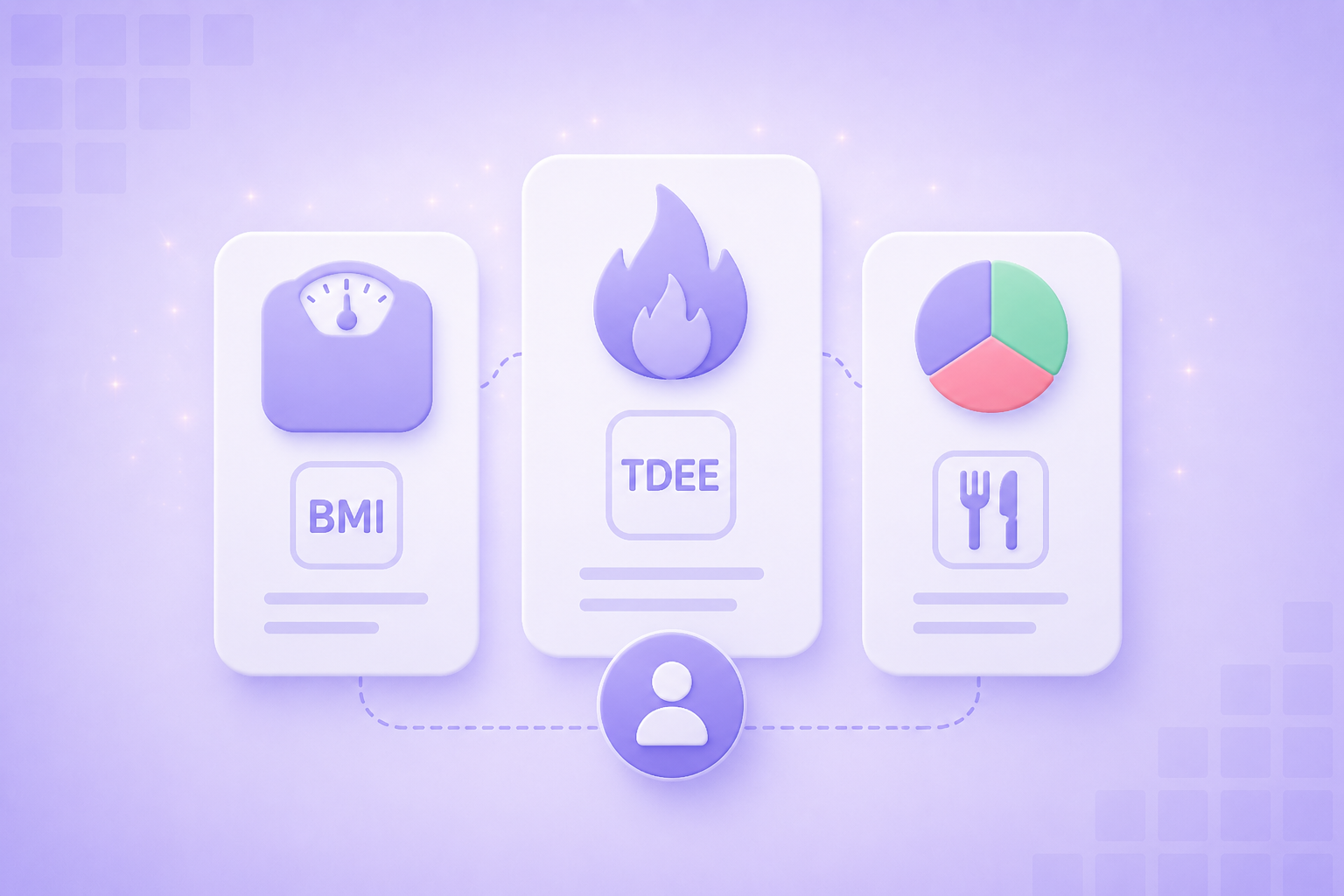
Search "BMI vs TDEE" and you'll find plenty of definitions but not much on which one to actually use, or in what order. Here's the short version: they measure three different things, and used in sequence, they turn a vague health question into an actual daily number you can plan meals around.
What BMI actually measures
Body Mass Index is a ratio of weight to height, nothing more. The BMI Calculator gives you that number in seconds, and it's a reasonable population-level screening tool: it flags whether someone is likely underweight, in a typical range, or in a higher-risk range. Its well-known limitation is that it can't tell muscle from fat — a heavily muscled athlete and someone carrying excess body fat can post an identical BMI. Treat it as a first, rough checkpoint, not a verdict.
What TDEE tells you that BMI can't
Total Daily Energy Expenditure estimates how many calories your body burns in a day, including activity level, not just resting metabolism. This number is the actual foundation of any weight goal: eat consistently below it and you lose weight, eat above it and you gain, eat at it and you maintain. The TDEE Calculator walks through your basal metabolic rate and activity multiplier to land on a number you can use to plan meals — something BMI, being a single ratio of height and weight, was never built to do.
What a macro calculator adds on top of TDEE
Once you have a calorie target, the next question is what that target is made of — protein, carbs, and fat. Two people eating the same 2,200 calories a day can get very different results depending on whether 30% of that is protein or 10%. The Macro Calculator takes your TDEE and goal (cut, maintain, or build) and breaks it into grams of protein, carbs, and fat, plus an estimated body fat percentage and ideal weight range — the natural next layer of detail once TDEE gives you a calorie number.
The order that actually makes sense
- Start with BMI as a two-second sanity check, not a target to chase.
- Calculate your TDEE to get an actual calorie number tied to your activity level and goal.
- Run your TDEE and goal through the macro calculator to turn that number into a daily protein, carb, and fat target you can plan meals around.
Skipping straight to a macro calculator without knowing your TDEE means guessing at the calorie total the macros are supposed to add up to. Starting and stopping at BMI means never getting a number you can actually act on.
A quick example
Take two people who are both 5'9" and 170 lbs — identical BMI. One is a sedentary office worker, the other trains four times a week. Their BMI is the same, but their TDEE could differ by 500 calories or more, and their macro splits would look completely different once muscle maintenance and recovery are factored in. This is exactly why BMI alone can't guide a nutrition plan — it has no idea about activity level, body composition, or goals.
When to skip BMI entirely
If you're an athlete, bodybuilder, or someone who trains heavily, BMI is close to useless — it will often flag you as "overweight" purely because muscle weighs more than fat per unit of volume. In that case, go straight to TDEE and macros, and use the estimated body fat percentage from the macro calculator as a far more useful reference point than BMI.
Common mistakes people make with these calculators
- Treating BMI as a diagnosis instead of a rough screening number
- Picking a macro split before knowing an accurate TDEE, so the numbers don't add up to a real calorie target
- Ignoring activity level changes — a TDEE calculated during a sedentary month won't hold up once training frequency changes
- Recalculating TDEE and macros only once, instead of updating them every 10-15 lbs of weight change or major activity shift
Frequently Asked Questions
Is BMI useless?
Not useless, but limited. It's a fast screening number for large populations. For an individual, especially anyone with more muscle mass than average, it can be misleading. Treat it as a first checkpoint, not a diagnosis.
What is the difference between BMR and TDEE?
BMR (basal metabolic rate) is the energy your body burns at complete rest. TDEE adds your activity level on top of BMR, which is why TDEE is the number to actually use for calorie planning — BMR alone ignores exercise and daily movement entirely.
Should I calculate my macros before or after my TDEE?
After. Macros are a breakdown of a calorie target, so you need an accurate TDEE, adjusted for your goal, before splitting it into protein, carbs, and fat.
How often should I recalculate these numbers?
Recheck your TDEE and macros every time your weight changes by about 10-15 lbs, or whenever your activity level changes significantly, such as starting or stopping a training program.
Can two people with the same BMI need completely different calorie targets?
Yes. BMI only accounts for height and weight. Two people with an identical BMI can have very different TDEE numbers if their activity levels differ, which is exactly why TDEE, not BMI, should drive your calorie target.
Do I need all three calculators, or just one?
For a casual health check, BMI alone is fine. For an actual nutrition or training plan, use TDEE to get your calorie target and the macro calculator to break it into protein, carbs, and fat — BMI at that point is mostly a background reference.